
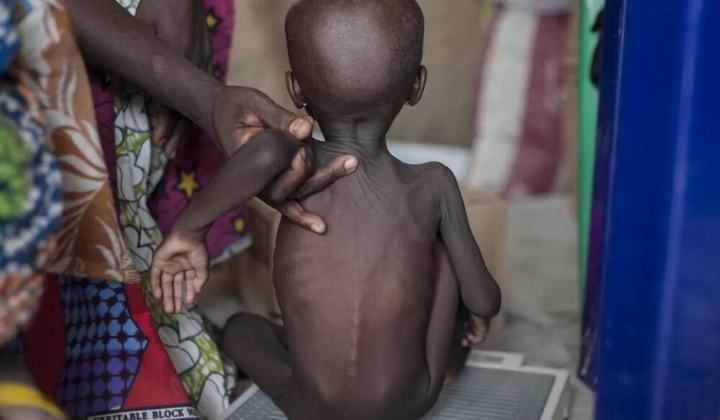
Nigeria’s failure to translate nutrition policies and funding commitments into measurable results has come under scrutiny, with the Athena Centre for Policy and Leadership calling for performance-based financing, stronger legislative oversight and tougher accountability measures to tackle child malnutrition.
The centre said under-five stunting in Nigeria stood at 40 per cent, far above the expired national target of 18 per cent, highlighting the gap between government commitments and actual implementation.
Speaking at a policy webinar in Abuja, the Director of the Olikoye Ransome-Kuti Institute for Health and Social Equity, Dr Danjuma Iyaji, said Nigeria had developed systems for measuring nutrition outcomes without establishing mechanisms to hold public officials accountable.
“Nigeria has built the measurement architecture of nutrition accountability without building its consequence architecture,” Iyaji said.
The webinar, organised by the Athena Centre through its institute, was titled From Measurement to Consequence: Fixing Nigeria’s Nutrition Accountability Gap. It examined findings from the centre’s policy paper, Political Incentives and Nutrition Neglect: Why State Governments Fail to Improve Child Nutrition.
The discussion brought together officials from the Office of the Vice President, the National Primary Health Care Development Agency (NPHCDA) and the House of Representatives Committee on Nutrition and Food Security to examine why policy commitments were failing to translate into better nutrition outcomes.
According to the centre, only nine of Nigeria’s 36 states had formally established State Councils on Nutrition as of April 2026. It noted, however, that establishing such councils did not necessarily mean they were fully functional.
To close the accountability gap, the centre proposed linking supplementary funding to independently verified readiness, conducting annual state performance assessments, establishing an escalation framework for persistent non-performance and holding annual nutrition accountability hearings at state level.
Participants, however, stressed that accountability measures must not deprive vulnerable children of essential nutrition services because their state governments failed to meet administrative requirements.
The Senior Special Assistant to the President on Nutrition and Public Health, Uju Rochas-Anwukah, supported the centre’s assessment, identifying three major breaks in the accountability chain: commitments failing to translate into fund releases, released funds not translating into service delivery, and inadequate understanding of nutrition priorities among subnational leaders.
“A stunted child is a lost asset that no bridge can build,” she said.
Rochas-Anwukah cautioned that readiness-based financing must not disadvantage states with the greatest nutrition needs but weaker implementation capacity. She also clarified that the terms governing the Child Nutrition Fund rested with UNICEF and its partners, rather than her office.
She called for a pathway to help less-prepared states build the capacity needed to qualify for support without leaving vulnerable children behind. She also urged the passage of the proposed National Food and Nutrition Bill to sustain accountability beyond individual administrations.
The Director of Nutrition at NPHCDA, Dr Adebiyi Olatunde, said accountability must extend beyond state-level indicators to primary healthcare facilities, where the availability of therapeutic foods and micronutrients directly affects access to treatment and preventive services.
She warned that state-level figures could conceal serious deficiencies in individual communities and healthcare facilities.
“At times we have data for a state, and the issue may be in only two particular wards,” Olatunde said.
She advocated collecting data down to ward and facility levels to identify localised failures. She also called for root-cause assessments before sanctions to determine whether poor performance resulted from funding shortages, supply-chain problems or implementation weaknesses.
The Research Lead for the House of Representatives Committee on Nutrition and Food Security, Abel Okechukwu, described conditional financing as “workable and urgently needed”, but said it should combine protected funding for essential services with incentives for improved performance.
He proposed allocating 70 per cent of funding as a protected lifeline for interventions such as micronutrient provision and school feeding, while reserving 30 per cent as performance incentives linked to functional nutrition councils, approved costed plans and published expenditure records.
“Conditional financing should not punish the child,” Okechukwu said.
He also called for stronger legislative scrutiny, arguing that oversight hearings must be backed by reliable data and adequate preparation rather than conducted as ceremonial exercises. He proposed standardised reporting templates and the submission of reports at least 21 days before hearings.
Okechukwu said the committee intended to intensify joint oversight in 2026 and 2027. He also proposed inserting a provision in the Appropriation Act to link federal grants to evidence that state governments had exercised appropriate oversight.
The discussions refined several recommendations, particularly the need to protect essential nutrition funding, provide weaker states with a pathway to meeting readiness requirements, assess performance below state level and make root-cause reviews the starting point for addressing persistent failures.
However, whether existing Child Nutrition Fund arrangements permit the proposed financing conditions remains unresolved, according to the centre’s policy paper.
As part of its follow-up plans, the Athena Centre said it would engage partners in the Child Nutrition Fund on financing conditions, present the proposed escalation framework to the Nigeria Governors’ Forum and submit its legislative recommendations to State Houses of Assembly.
It also plans to circulate a policy note incorporating the panellists’ recommendations before publication and reassess the four proposed reforms in July 2027.
In closing, the webinar moderator and researcher at the institute, Ijeoma Achebe, said the discussion had strengthened the paper’s diagnosis.
“The gap is not simply about a lack of policies,” she said. “It is the distance between commitments and delivery.”