
By Dr. Abiola Bashorun
Beyond the Beauty of Trees
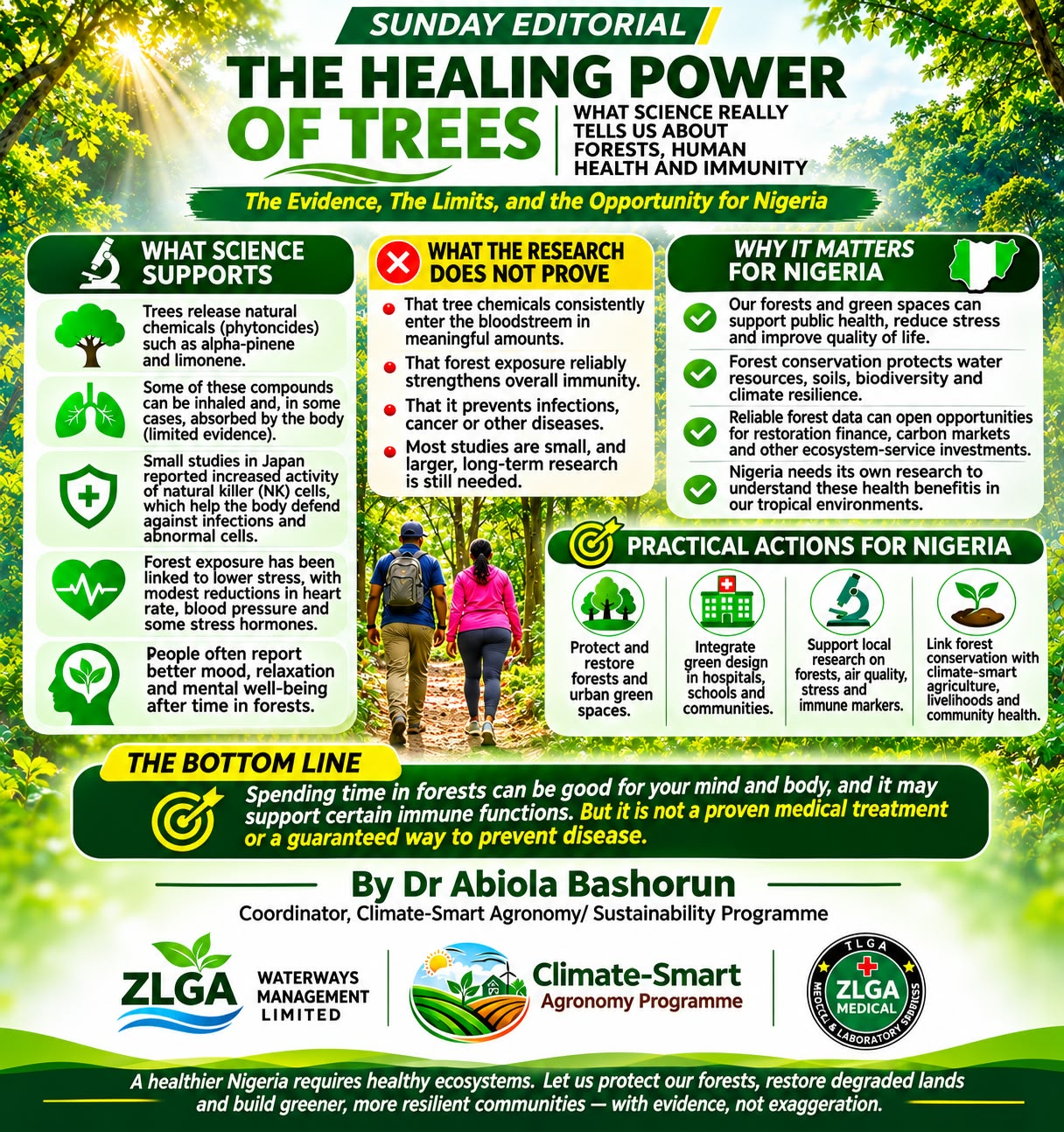
For generations, we have appreciated trees for their shade, fruits, timber, oxygen production and environmental benefits. We recognise forests as important natural assets that support biodiversity, regulate local temperatures, protect watersheds and contribute to climate resilience.
But emerging scientific research invites us to consider another important dimension: the relationship between forests and human health.
Could the simple act of walking through a forest, breathing its air and spending time among trees influence our stress levels and immune systems?
Japanese researchers have spent years investigating this question. Their findings are fascinating, but they also require careful interpretation.
In an age when scientific information spreads rapidly through social media, we must distinguish between what research suggests and what science has conclusively established.
The Japanese Experience: Understanding Forest Bathing
Japan has popularised a practice known as Shinrin-yoku, commonly translated as forest bathing.
Contrary to what the name might suggest, forest bathing does not involve swimming or taking a bath. It simply means spending time in a forest environment, engaging with nature through sight, smell, sound and gentle physical activity.
Professor Qing Li and other Japanese researchers have investigated how forest exposure may influence human physiology.
One particularly interesting area of research concerns natural killer cells, commonly called NK cells.
These specialised immune cells help the body recognise and destroy certain virus-infected and abnormal cells.
In a small study published in 2007, researchers reported increased NK-cell activity following a three-day forest visit involving 12 healthy men.
Subsequent studies also reported changes in immune-related markers following forest exposure.
These findings suggest that forest environments may influence certain aspects of immune function.
However, an important scientific distinction must be made.
An increase in NK-cell activity does not automatically mean that a person’s overall immunity has improved or that the individual is better protected against infections, cancer or other diseases.
The original studies were relatively small, and larger, well-controlled clinical investigations are needed to establish lasting health benefits.
What About the Chemicals Released by Trees?
Trees naturally release volatile organic compounds, including substances known as phytoncides.
Examples include alpha-pinene and limonene, compounds that contribute to the characteristic fragrance of forests.
Some laboratory studies suggest that certain plant-derived compounds may influence biological processes associated with immune activity.
There is also evidence that humans can inhale and absorb some forest-related volatile compounds.
However, the scientific evidence does not establish that breathing these substances at normal forest concentrations consistently produces clinically meaningful improvements in immunity.
A human study published in 2021 investigated exposure to forest-related compounds and their presence in blood. Its findings were mixed and did not demonstrate a significant overall increase in blood concentrations between forest and urban exposure groups.
Therefore, the popular assertion that chemicals released by trees enter our bloodstream and automatically strengthen our immune systems goes beyond what current evidence can support.
We should welcome scientific discovery without exaggerating its conclusions.
Forests, Stress and Mental Well-being
The evidence becomes more encouraging when we examine the relationship between natural environments and psychological stress.
Several studies have associated forest exposure with improvements in mood, relaxation and certain physiological indicators of stress.
Researchers have reported reductions in heart rate, blood pressure and some stress-related hormonal measurements following forest visits.
A 2026 systematic review and meta-analysis also reported modest average reductions in heart rate and systolic blood pressure.
However, the authors assessed the certainty of the evidence as very low, meaning the magnitude and reliability of these effects remain uncertain.
Furthermore, scientists cannot yet fully separate the effects of tree-derived chemicals from other beneficial features of forest environments.
Walking, physical exercise, reduced traffic noise, cleaner surroundings, social interaction and temporary relief from daily pressures may all contribute to the observed benefits.
Nevertheless, the broader public health message remains relevant.
Access to safe, well-maintained green spaces can support physical activity, recreation, relaxation and community well-being.
These are worthwhile public health objectives even without claiming that forests cure diseases.
Nigeria Must Begin to See Forests Differently
For Nigeria, the implications extend beyond scientific curiosity.
Our country faces significant environmental pressures, including deforestation, land degradation, urban expansion, rising temperatures and declining access to quality green spaces in many communities.
We often discuss forest conservation principally in terms of timber, carbon sequestration, biodiversity and climate change.
These are legitimate and important considerations.
But we must also begin to recognise forests and urban green infrastructure as potential contributors to public health and quality of life.
Imagine Nigerian cities where urban planning deliberately incorporates accessible green corridors, tree-lined streets, community parks and protected natural spaces.
Imagine hospitals, schools and residential communities designed with greater attention to vegetation, shade, outdoor recreation and environmental comfort.
Such initiatives could help reduce heat exposure, encourage physical activity and improve the quality of urban environments.
They would also create opportunities for scientific research into the relationship between environmental conditions and human health.
However, the benefits depend on proper planning. Tree species, pollen exposure, air pollution, maintenance, water availability and public safety must all be considered.
Planting trees without understanding their ecological suitability or long-term maintenance requirements is not sound environmental management.
A New Opportunity for Climate-Smart Agronomy and Public Health
Under the Climate-Smart Agronomy/Sustainability Programme, we believe that environmental sustainability must increasingly be connected with measurable improvements in human welfare.
Forest restoration, soil rehabilitation, biodiversity conservation and climate-resilient landscapes should not be viewed as isolated environmental activities.
They can form part of an integrated development framework that supports agriculture, livelihoods, climate adaptation and healthier communities.
Nigeria has an opportunity to develop research partnerships involving universities, medical institutions, environmental laboratories and forestry agencies.
Such partnerships could investigate how different natural environments influence human health, including stress-related indicators, air quality, heat exposure and selected immune-system measurements.
Importantly, research should include appropriate comparison groups and follow participants over time.
We must move beyond assumptions and build reliable local evidence.
Our tropical forests, savannah ecosystems, mangrove environments and urban green spaces differ significantly from the temperate forests studied in Japan.
Consequently, Japanese research findings should not simply be transferred to Nigeria without local scientific validation.
Forest Conservation Is Also an Economic Question
Forests provide economic value through ecosystem services, including watershed protection, erosion control, carbon storage, biodiversity conservation and support for sustainable livelihoods.
Reliable forest inventories and credible environmental data could also help Nigeria evaluate opportunities in restoration finance, carbon markets and other ecosystem-service investments.
Such investments, however, require transparent measurement, verification, safeguards and realistic financial assessments.
Potential human health benefits may strengthen the public policy case for conserving and restoring forests, but they should not be automatically converted into financial claims without evidence.
This is where environmental science, public health, economic planning and responsible investment must work together.
My Sunday Reflection
The Japanese research offers an important lesson.
Nature may contribute to human well-being in ways that we are only beginning to understand.
But scientific enthusiasm must never replace scientific discipline.
We can reasonably say that spending time in forests may help reduce stress and that some small studies have observed changes in immune-cell activity.
We cannot yet conclude that forest exposure reliably strengthens overall immunity, prevents disease or provides a substitute for established medical treatment.
For Nigeria, the greater lesson is that protecting our forests is not merely about preserving trees.
It is about protecting ecological systems that support our water resources, agricultural productivity, climate resilience, biodiversity and potentially aspects of human well-being.
As we continue to confront environmental degradation, we should ask ourselves a fundamental question:
Are we adequately measuring the true environmental, economic and public health value of the forests we are losing?
Until we understand what we have, we cannot fully appreciate what we stand to lose or what we might gain through responsible restoration.
Forests should not be romanticised as miracle hospitals.
Neither should they be dismissed as undeveloped land waiting to be cleared.
They are living ecological infrastructure deserving of scientific attention, responsible investment and long-term protection.
The future of environmental sustainability must be built on evidence, not exaggeration; conservation, not exploitation; and development that recognises the inseparable relationship between healthy ecosystems and healthy communities.
That is the direction we must pursue.
—
Dr. Abiola Bashorun
Coordinator
Climate-Smart Agronomy/Sustainability Programme (Nigeria & USA)
ZLGA Waterways Management Limited
Scientific References
1. Li, Q. et al. (2007). Forest bathing enhances human natural killer activity and expression of anti-cancer proteins. International Journal of Immunopathology and Pharmacology.
2. Li, Q. et al. (2008). Visiting a forest, but not a city, increases human natural killer activity and expression of anti-cancer proteins. International Journal of Immunopathology and Pharmacology.
3. Human exposure research on forest-related monoterpenes and their detection in blood (2021), indexed in PubMed.
4. Systematic review and meta-analysis of forest bathing and selected cardiovascular and psychological outcomes (2026), indexed in PubMed.
Editorial note: The research findings discussed above do not establish forest bathing as a treatment or prevention strategy for any specific disease.