Commuters across Nigeria are still waiting for widespread transport fare reductions from Compressed Natural Gas (CNG)-powered vehicles, despite more than $2.5bn in private investment reportedly mobilised under the Federal Government’s CNG initiative.
The Presidential Initiative on CNG and Electric Vehicles (Pi-CNG and EV) said it had begun engaging state governors, transport unions and commercial fleet operators to promote lower fares and improve transparency in the public transport system.
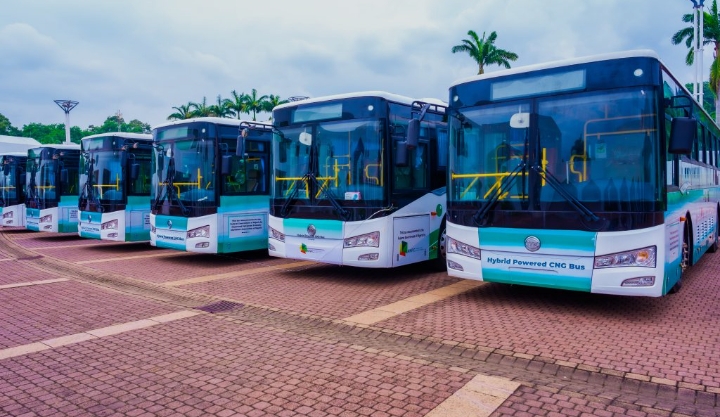
The initiative plans to introduce stickers displaying designated routes and approved fares on buses to prevent overcharging and help passengers know how much they should pay.
The Head of Brand and Communications, Onyekachi Eke, said the agency had started meeting governors to map out routes and implement fare reductions.
“Henceforth, for every bus we give, there will be a sticker to map out the intended routes. The routes will be placed on the buses as stickers, and the fare will be there,” she said.
Eke disclosed that Abuja was recording a 40 per cent fare reduction on designated routes through a partnership with the National Union of Road Transport Workers (NURTW). She said similar reductions had been recorded in Borno, Enugu, Niger and Abia states, although the measures had yet to cover every route.
The initiative has attracted more than $2.5bn in private investment across refuelling infrastructure, vehicle conversion centres and vehicle assembly. Federal Government interventions have also covered vehicle procurement, conversion incentives and technical training.
Other components include Project Sprout, which will provide buses to 20 universities in its first phase, and a planned partnership with ride-hailing platform inDrive.
Tinubu Directs Nationwide Fare Reductions
President Bola Tinubu announced on August 27, 2026, that the Federal Government and state governors had agreed to reduce transport fares nationwide from October 1 by promoting cheaper energy sources.
“Cheaper fuel should result in cheaper fares,” the President said.
Tinubu disclosed that more than 120,000 vehicles had been converted to CNG, with another 100,000 conversion kits in the pipeline. He also cited more than 100 gas projects financed through the Midstream and Downstream Gas Infrastructure Fund.
The President directed the rollout of 1,000 CNG stations nationwide. On September 19, a joint implementation committee chaired by Kwara State Governor AbdulRahman AbdulRazaq was established to coordinate implementation.
On October 11, Tinubu cited reported fare reductions on selected routes, including Masaka to Berger in the Federal Capital Territory, where fares reportedly dropped from N1,500 to N500, and Enugu to Nsukka, where fares fell from N4,000 to N1,600.
Despite these examples, implementation remains uneven across the states, leaving many commuters without the expected relief.
States Record Uneven Progress
Findings across several states indicate differences in investment, vehicle deployment, infrastructure development and the implementation of fare reductions.
In Bayelsa, the state budgeted N25bn for CNG buses, but the available findings did not confirm that CNG buses were operating in Yenagoa.
In Imo, fares at major parks in Owerri reportedly remained unchanged, with some journeys, including Owerri to Umuahia, costing as much as N4,500. The All Progressives Congress (APC) said the delivery of CNG vehicles had begun.
Kaduna State has 100 CNG buses and expects another 120, bringing its planned fleet to 220. The state is also working on bus rapid transit terminals.
Sokoto and Kebbi have concentrated on conventional buses alongside CNG conversion efforts. Sokoto budgeted N3.45bn for buses and was converting 20 vehicles at N750,000 each. Kebbi budgeted N5.25bn for 100 18-seater buses and has deployed more than 50. The state also has a Federal Government CNG conversion centre in Birnin Kebbi, although fares were reportedly unchanged.
In Benue, the government has yet to procure buses, focusing instead on public awareness and training. Jigawa claims to have converted 100 vehicles, but with only one CNG station in Dutse, fares on the Dutse-Kano route reportedly remain N3,500.
Zamfara has no CNG station, while Bauchi has yet to commit to the initiative. Kano received 40 CNG buses from the Federal Government in June and has procured 500 electric tricycles, but transport fares have continued to rise amid higher petrol prices.
Nasarawa is training 50 technicians and plans to establish conversion centres in three zones. Borno claims that 80 per cent of its buses are powered by CNG or electricity, with some trips reportedly costing N50. Niger State, meanwhile, spent N7bn on 200 50-seater CNG buses.
Taraba expects mobile CNG stations to arrive by November. Kogi budgeted N1bn for the initiative, but the funds had yet to be released, with the state planning a memorandum of understanding with Vostok Meridian.
Adamawa is launching 100 electric tricycles and has promised 1,000 for workers. Abia is focusing on electric buses, citing gas supply and mother-station challenges, while offering a 50 per cent transport fare subsidy.
Transport Unions Seek Clarity
The implementation of the fare reduction policy has also raised questions about coordination with transport operators.
The President of the Road Transport Employers Association of Nigeria (RTEAN), Musa Mohammed, said he had not been briefed on the enforcement arrangements. The President of the NURTW, Musiliu Akinsanya, did not respond to requests for comments.
The reported lack of communication with some transport operators raises concerns about how consistently approved fares will be implemented and monitored across different routes.
FG Introduces Buses for Civil Servants
Separately, the Federal Government has provided 10 mass transit buses for federal civil servants.
The Head of the Civil Service of the Federation directed that enrolment for the service close on October 7, 2026, to enable the government to identify routes with high demand before expanding the scheme.
Ultimately, the success of the CNG initiative will depend on whether investments in cheaper fuel, conversion infrastructure and mass transit vehicles translate into sustained fare reductions for ordinary Nigerians.
Although CNG-powered vehicles can have operating costs substantially lower than petrol-powered alternatives, the anticipated savings will benefit commuters only if transport operators pass them on through lower fares.