
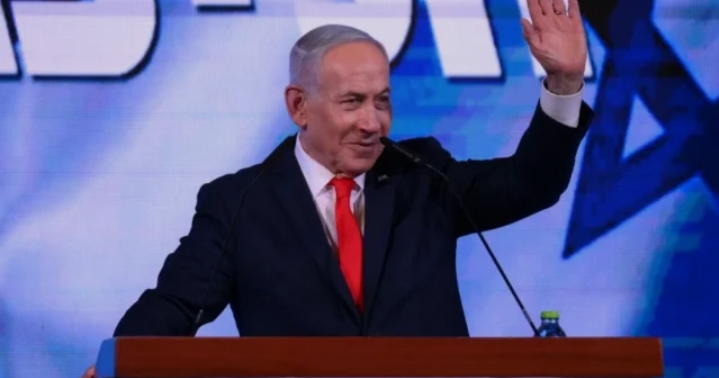
Israeli Prime Minister Benjamin Netanyahu is leading his main rival, former military chief Gadi Eisenkot, in the country’s general election, but his right-wing bloc remains short of a parliamentary majority, according to partial results reported by the BBC.
With 85 per cent of ballots counted, Netanyahu’s Likud party and its far-right and ultra-Orthodox Jewish allies were projected to secure 53 seats in the 120-member Knesset, while Eisenkot’s Yashar party and three other Jewish opposition parties in his bloc were on course to win 48 seats.
Arab-led parties were projected to win a combined 19 seats, potentially giving them a decisive role in determining the next government. However, most Jewish parties have ruled out working with them.
Between 430,000 and 480,000 absentee ballots, including votes from soldiers, diplomats and hospital patients, were still awaiting counting, meaning the final results could take another day or two to emerge.
Once the results are confirmed, President Isaac Herzog will consult political factions before inviting the candidate he believes has the best chance of forming a government. The coalition-building process could take weeks, and failure to reach an agreement could lead to another election.
Herzog praised the 77.7 per cent voter turnout recorded on Tuesday, describing it as Israel’s highest in more than two decades.
Speaking at his residence in Jerusalem, he said the turnout demonstrated the strength of democratic participation and urged political leaders to approach coalition negotiations with an open mind to avoid another election.
Both Netanyahu and Eisenkot have insisted they should be given the opportunity to form the next government.
Eisenkot said the public had voted for change after initial exit polls suggested his Change Bloc could win between 52 and 53 seats, compared with 50 for Netanyahu’s bloc.
“The coalition of failure has lost the people’s trust,” he told supporters at Yashar’s election headquarters in Tel Aviv, pledging to work with his partners to form a government.
However, subsequent exit-poll updates narrowed the gap, with two Israeli broadcasters projecting a tie between the rival blocs at 51 seats each, while another gave Netanyahu’s bloc a three-seat lead.
Netanyahu, speaking at Likud’s headquarters in Jerusalem, declared that his right-wing bloc had won a “great majority” and called for a strong right-wing national government.
He also rejected the possibility of forming a government that depends on Arab parties, describing them as anti-Zionist.
As counting continued on Wednesday, Netanyahu’s bloc performed better than the initial exit polls had suggested, with 53 seats projected. The figure, however, remained 15 seats below the bloc’s previous strength in the outgoing Knesset.
The election was Israel’s first since the Hamas-led attacks of October 7, 2023, which killed about 1,200 people and saw 251 others taken hostage, triggering wars in Gaza and subsequent regional conflicts involving Lebanon and Iran.
The vote was widely regarded as a defining moment for Israel’s political direction, with voters weighing questions about national security, accountability for the October 7 attacks, military service for ultra-Orthodox Jewish men, judicial reforms and the country’s international standing.
Avigail Levine, from Kfar Saba, who voted for former prime minister Naftali Bennett’s Beyachad party, said she had hoped for new leadership.
She argued that those who were in power when the October 7 attacks occurred should be held accountable. Her husband’s grandmother was among those killed in Kibbutz Be’eri.
Another voter, Gal, from Ramat Gan, said he supported Netanyahu because he feared Israel’s neighbours did not want the country to exist. He also expressed concern about the growing representation of Arab political parties.
Meanwhile, Likud alleged that election-related misconduct, including bribery, threats, violence and fraud, had affected the vote, but provided no evidence to support its claims. The Central Elections Committee said it would examine the allegations as part of its post-election review.
The United Arab List and the Joint List, the two Arab-led political parties, were projected to nearly double their representation amid increased turnout among Arab citizens of Israel, who make up about one-fifth of the population and often identify as Palestinian citizens of Israel.
Mahdi Kabaha, who campaigned to encourage Arab voter participation, described the outcome as historic, saying Arab citizens had clearly expressed their desire for a greater say in the country’s political affairs.
Joint List leader Yousef Jabareen said some Arab voters were motivated by the prospect of removing far-right National Security Minister Itamar Ben-Gvir from office. Jabareen accused Ben-Gvir of racism and provoking Arab communities.
Ben-Gvir, leader of the Jewish Power party, has advocated annexing the occupied West Bank, establishing Jewish settlements in Gaza and encouraging what he calls the voluntary emigration of Palestinians. Several Western countries have imposed sanctions on him over allegations of incitement against Palestinians.
United Arab List leader Mansour Abbas, who participated in a short-lived governing coalition formed after the 2021 election, expressed hope that the numbers would allow his party to cooperate with Eisenkot’s Change Bloc to reach the 61 seats required for a parliamentary majority.
Yair Golan, leader of the left-wing Democrats party, also urged opposition partners to consider forming a government with Arab parties to replace Netanyahu’s coalition, arguing that meaningful political change required confronting racism.
However, Eisenkot has previously expressed reservations about such an alliance and attached conditions, including recognition of Israel as a Jewish and democratic state and acceptance that Hamas is a terrorist organisation that must be destroyed. Right-wing parties within his own bloc have also rejected the proposed arrangement.
Jabareen said opposition parties would need to negotiate with Arab representatives if they genuinely wanted to establish an alternative government.
With absentee ballots still outstanding and coalition negotiations yet to begin, Israel faces an uncertain political future despite Netanyahu’s lead in the partial election results.