
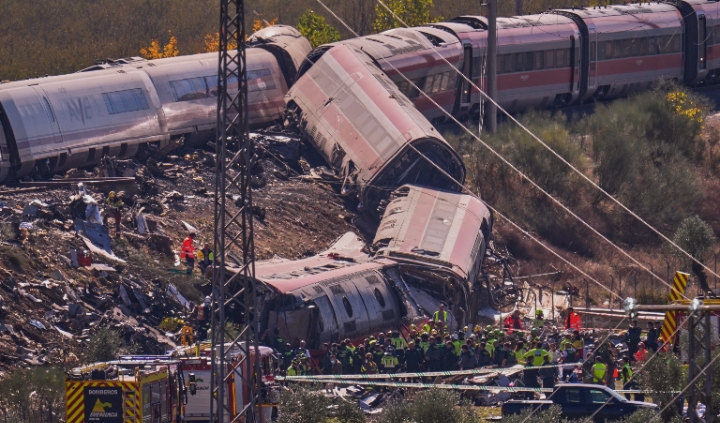
At least 68 people have been killed and dozens injured in a high-speed train crash in central Spain, in one of the country’s deadliest rail disasters in recent years.
The crash occurred on Wednesday morning when a train travelling from Madrid to Seville collided with another train that had stopped on the tracks. The impact sent several carriages tumbling down an embankment.
Spain’s Transport Minister, Óscar Puente, said a computer failure followed by human error was suspected to have contributed to the crash, which is among the worst rail disasters in modern European history and Spain’s deadliest train accident in 13 years.
Survivors described terrifying scenes as passengers were thrown into the air, trapped beneath wreckage and forced to smash windows to escape. Some carriages were severely damaged, while one caught fire.
The crash happened shortly after 9 a.m. local time, about 140 kilometres south of Madrid, between the municipalities of Mora and Orgaz.
According to Puente, the stationary train, operated by private rail company Iryo, had 147 passengers on board and stopped because of a computer failure.
He explained that a 24-hour control centre in Madrid takes over when such system failures occur. However, he said the centre made an “inexplicable” decision to instruct the trains to move again without imposing speed restrictions. Wow
Iryo said its train was “struck from behind” by another train operated by Spain’s state-owned railway company, Renfe, which was carrying 397 passengers.
Salvador Arriza, 62, who was travelling on the Renfe train, described the force of the collision as “brutal”.
Speaking to Reuters, he said passengers began breaking windows to escape, while some remained trapped between the seats and were unable to move.
Other survivors recounted scenes of devastation, with injured passengers crying for help amid smoke, blood and debris. Photographs from the scene showed a long section of railway track piercing through one of the carriages.
Tangui Binier, 22, who was travelling on the Iryo train, told the BBC that suitcases began flying through the carriage as passengers screamed before the train came to a halt.
He described seeing a carriage completely overturned after stepping outside, amid smoke and confusion. His father helped carry a girl with a broken hip out of the wreckage.
Binier also described seeing dead bodies and people with severe injuries, saying he did not know whether he would ever recover from the experience.
Spanish journalist Antonio Jiménez Barca, who works for El País newspaper, was walking towards the Renfe train’s cafeteria when the crash occurred.
He said he felt as though he had been pushed from behind and thrown to the ground. He suffered a head injury and found himself covered in blood, with other injured passengers lying on top of him.
Another passenger, 46-year-old Sebastián Herrero, told El Mundo newspaper that he saw numerous people with broken noses and arms after what he described as a terrible impact.
Several passengers said they remained in shock after the collision. One man broke down in tears during a local television interview as he recounted how a woman died in his arms.
Emergency services rushed dozens of ambulances to the scene, while a helicopter evacuated passengers with the most serious injuries.
Spain’s Civil Guard said DNA samples from relatives would be needed to identify some of the victims.
Prime Minister Pedro Sánchez, who visited the crash site, expressed condolences to the victims and their families, saying the entire country was mourning the tragedy.
“Lives have been shattered, families have been torn apart, the pain is immense,” he said.
Most political parties cancelled campaign events scheduled for Wednesday in response to the disaster.
The far-right Vox party, however, said it would not participate in what its leader, Santiago Abascal, described as attempts to use national mourning to silence criticism of Spain’s rail infrastructure.
The latest disaster comes as Spain continues to grapple with another major high-speed rail crash near Córdoba in January, which killed 46 people. That accident occurred on the same rail line, although much farther south.
Sánchez described the occurrence of two serious train crashes in one year as unacceptable and pledged a thorough investigation to establish the circumstances surrounding the latest incident and determine whether negligence was involved.
Alberto Núñez Feijóo, leader of the main opposition People’s Party, said Spaniards had the right to understand what was happening with the country’s infrastructure and called for any failures in the railway safety system to be addressed firmly.
Meanwhile, the Spanish trade union CSIF called for the transport minister’s resignation, accusing him of shifting blame onto a traffic manager by citing human error rather than taking responsibility for the disaster.
The crash is Spain’s deadliest rail accident since 2013, when 80 people died in a high-speed train derailment near Santiago de Compostela in the country’s north-west.