
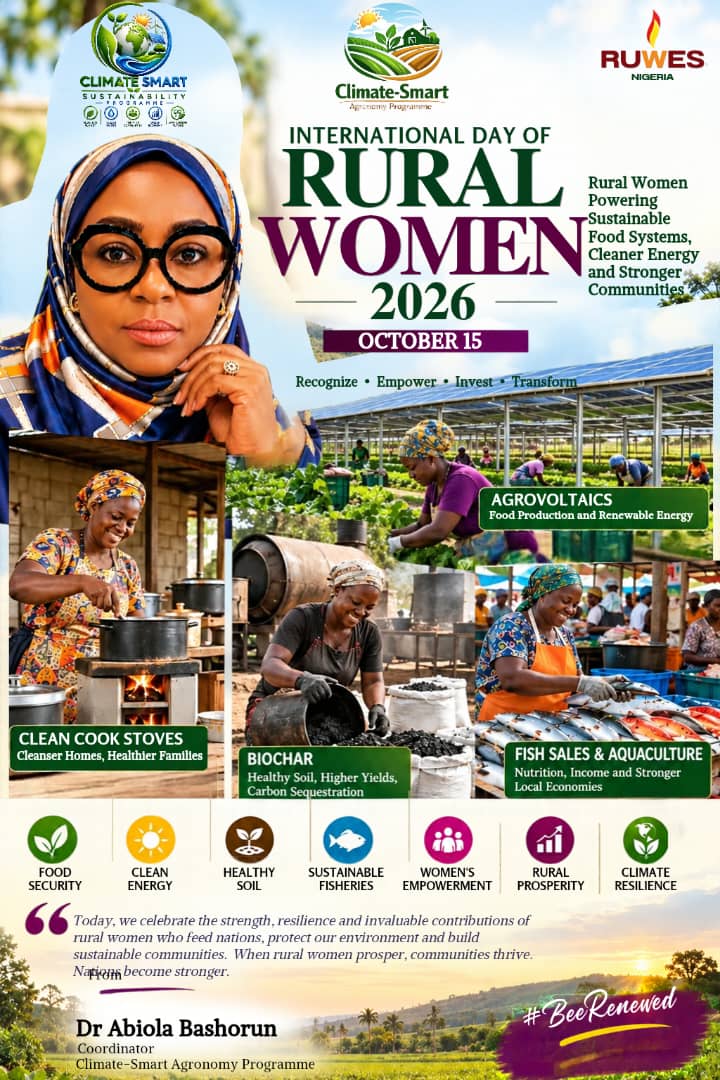
By Dr. Abiola Bashorun
Every year, October 15 provides the world with an important opportunity to recognise a group of women whose contributions remain indispensable to humanity’s survival, yet whose sacrifices, ingenuity and economic importance are too often overlooked.
The International Day of Rural Women is more than a commemorative occasion. It is a reminder that the future of food security, environmental sustainability, economic resilience and inclusive national development depends significantly on how societies recognise, empower and invest in rural women.
Across Nigeria, Africa and much of the developing world, rural women are the backbone of agricultural production, household nutrition, local commerce and community stability. They cultivate the land, process agricultural produce, preserve indigenous knowledge, manage household resources and sustain local economies, frequently under conditions of limited financial access, inadequate infrastructure and increasing climate uncertainty.
Yet the question remains: How can nations genuinely achieve sustainable development while leaving behind the very women who sustain their rural economies?
Beyond Recognition: The Urgency of Economic Empowerment
Celebrating rural women must go beyond speeches, ceremonial gatherings and symbolic acknowledgements.
The real measure of national commitment lies in deliberate policies, institutional reforms and practical investments that improve their economic circumstances.
Rural women require affordable financing, secure access to productive land, modern agricultural equipment, quality seedlings, climate-resilient technologies, reliable markets, healthcare, education and digital financial services.
More importantly, they deserve recognition not merely as beneficiaries of development programmes but as investors, entrepreneurs, employers, innovators and essential partners in national economic transformation.
A woman who cultivates two hectares of farmland should have the opportunity to expand into commercial agriculture. A rural fish processor should be able to access modern cold-chain infrastructure, packaging facilities and export markets. A female agricultural cooperative should be capable of attracting structured financing and participating competitively in regional and international value chains.
Empowerment must translate into ownership, productivity, profitability and lasting economic independence.
Climate Change and the Increasing Burden on Rural Women
Climate change has introduced additional pressures on rural communities.
Unpredictable rainfall, flooding, soil degradation, drought, declining biodiversity and changing agricultural seasons increasingly threaten livelihoods.
For many rural women, these environmental disruptions mean longer working hours, reduced harvests, higher production costs and greater household vulnerability.
This is why climate-smart agriculture must become a central component of rural women’s economic empowerment.
Through the Climate-Smart Agronomy/Sustainability Programme, we advocate an integrated approach that connects sustainable agriculture, environmental restoration, water resource management, renewable energy, agribusiness development and community empowerment.
The objective is to create economically viable and environmentally responsible rural production systems capable of improving livelihoods while protecting natural resources for future generations.
Women must be positioned at the centre of this transformation.
From Subsistence Agriculture to Wealth Creation
Nigeria possesses enormous agricultural potential, yet the transformation of rural production into sustainable wealth remains a major developmental challenge.
The solution requires moving beyond traditional subsistence models towards organised agricultural enterprises supported by modern technology, financial innovation, value addition and market integration.
Rural women should be encouraged and supported to participate in agricultural cooperatives, agro-processing enterprises, aquaculture, organic fertiliser production, sustainable forestry, agricultural logistics and renewable-energy-supported businesses.
With appropriate safeguards and credible project structures, emerging opportunities in regenerative agriculture, ecosystem restoration and environmental markets may also create additional income streams for rural communities.
However, such opportunities must be designed to ensure that women are not merely participants in projects controlled by others but equitable beneficiaries of the economic value generated.
The Responsibility of Governments, Financial Institutions and Development Partners
Governments cannot accomplish this transformation alone.
Commercial banks, development finance institutions, international development agencies, private investors, research institutions and civil society organisations must work together to create practical pathways for rural women’s advancement.
Financial institutions should develop products that recognise agricultural production cycles and the commercial realities of rural enterprises.
Governments must improve rural roads, electricity, water supply, healthcare, education and agricultural extension services.
Universities and research institutions should strengthen the transfer of climate-smart technologies to farming communities.
Private-sector organisations should develop inclusive value chains that connect rural producers to domestic and international markets.
Partnerships must be measured by tangible improvements in livelihoods rather than the number of conferences organised or agreements announced.
A New Development Agenda for Rural Women
The celebration of International Day of Rural Women should inspire a renewed commitment to five fundamental outcomes: economic inclusion, environmental resilience, access to productive resources, institutional participation and intergenerational prosperity.
Particular attention must be given to young rural women, whose aspirations increasingly extend beyond traditional farming practices.
With education, digital technology, entrepreneurship training and access to capital, a new generation of female agribusiness leaders can emerge across Nigeria and Africa.
Their success would strengthen food systems, reduce rural poverty, generate employment and contribute meaningfully to national economic growth.
Conclusion: Celebrating the Women Who Sustain Nations
As the world marks International Day of Rural Women, we must acknowledge a fundamental truth: rural women are not peripheral to economic development. They are central to it.
Their labour sustains families. Their enterprises support communities. Their resilience strengthens food systems. Their knowledge preserves ecosystems. Their ambitions hold enormous potential for national transformation.
The challenge before governments, institutions and development partners is therefore not simply to celebrate rural women but to create the conditions in which their contributions receive appropriate recognition, investment and economic reward.
A nation that empowers its rural women strengthens its agriculture, secures its food systems, protects its environment and invests in the prosperity of future generations.
Let October 15, 2026, be remembered not only as a day of recognition but as a renewed call for measurable action.
When rural women prosper, communities thrive. When communities thrive, nations become stronger.
Dr. Abiola Bashorun is the Coordinator of the Climate-Smart Agronomy/Sustainability Programme, Nigeria and the United States of America.
#BeeRenewed