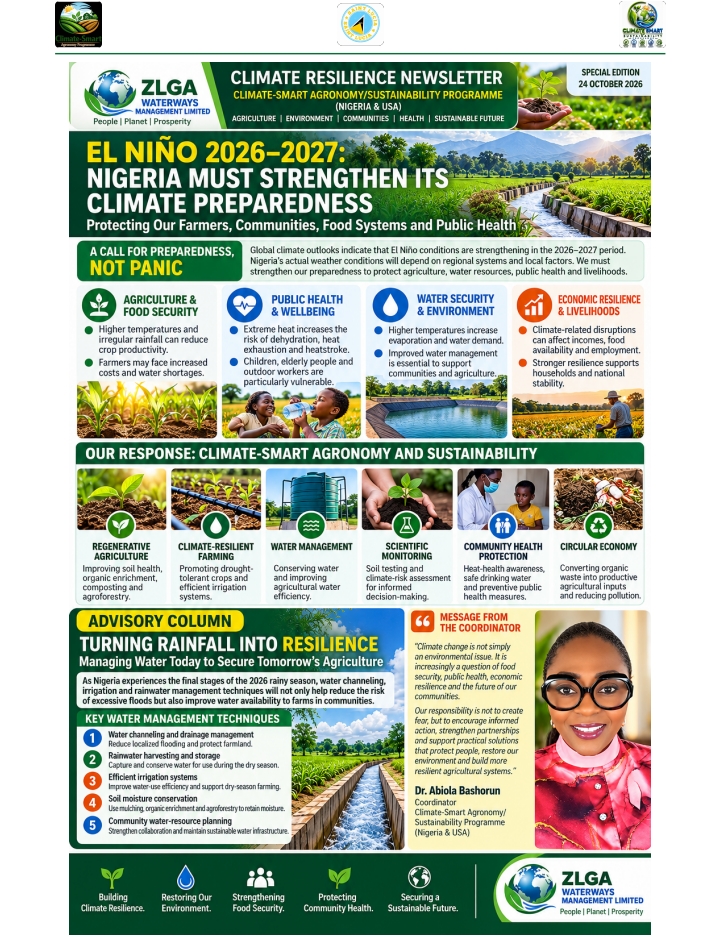
Nigeria must strengthen its preparedness for potential extreme heat, irregular rainfall, water shortages and threats to agricultural production as attention turns to the 2026–2027 El Niño climate pattern. Dr. Abiola Bashorun, Coordinator of the Climate-Smart Agronomy/Sustainability Programme (Nigeria & USA), made the call in a special edition of the Climate Resilience Newsletter issued on October 24, 2026, stressing the need for proactive planning rather than panic.
Bashorun noted that El Niño, a climate phenomenon associated with warming sea-surface temperatures in the tropical Pacific Ocean, can influence weather patterns worldwide but does not determine conditions uniformly across Nigeria. She explained that local outcomes also depend on the West African monsoon, Atlantic Ocean temperatures and other regional factors, making current forecasts and local vulnerability assessments essential for effective planning.
The newsletter identified agriculture, water security, public health and livelihoods as key areas requiring attention. It warned that high temperatures and irregular rainfall could reduce soil moisture, stress crops and livestock, increase production costs and disrupt food supplies. Increased evaporation and inadequate water infrastructure could also worsen water shortages, while extreme heat could raise the risk of dehydration, heat exhaustion and heatstroke, particularly among vulnerable people and outdoor workers.
To strengthen climate resilience, the programme advocates regenerative soil management, organic enrichment, agroforestry, climate-resilient crops, efficient irrigation, water-quality monitoring, environmental testing, community heat-health education and responsible waste-to-resource solutions. The publication described these as proposed priorities whose implementation and impact would require independent assessment.
It also called for region-specific preparedness, noting that northern Nigeria should pay particular attention to dry-season heat and water stress, while the Middle Belt should prioritise climate-informed planting and soil-moisture conservation. Southern communities, meanwhile, should consider humid heat, flooding, drainage management and water-quality risks. The newsletter emphasised that these priorities must be guided by current Nigerian Meteorological Agency forecasts and local conditions.
As the 2026 rainy season draws to a close at different times across the country, the programme is advocating improved drainage, rainwater harvesting and safe storage, efficient irrigation, mulching, organic soil enrichment and community water-resource planning. However, it cautioned that drainage channels cannot prevent every flood and stored rainfall cannot guarantee sufficient supplies during prolonged drought, stressing the importance of proper design, maintenance, water quality and consideration of downstream effects.
“The water that threatens our communities during periods of excessive rainfall can, where safely and appropriately managed, become a valuable resource for agricultural production during the dry season. Climate resilience begins with planning ahead,” Bashorun said. The newsletter advised Nigerians to consult updated information from the Nigerian Meteorological Agency, NOAA Climate Prediction Center, World Meteorological Organization and International Research Institute for Climate and Society, clarifying that its recommendations constitute preparedness guidance, not an official forecast or a guarantee of specific climate outcomes. The special edition was issued under the Climate-Smart Agronomy/Sustainability Programme (Nigeria & USA), with Bashorun as coordinator and ZLGA Waterways Management Limited identified in the publication.